Scoliosis Treatment in Chennai Measure the Curve. Protect Growth. Balance the Spine Safely.
Scoliosis means the spine has developed a sideways curve, often noticed as uneven shoulders, a rib hump, one-sided waist asymmetry or a curve seen on X-ray. Some curves only need observation and scoliosis-specific exercises; growing children may need bracing; adults may need treatment for pain, imbalance or nerve compression. This guide explains how Dr. Soma Sundar S evaluates scoliosis using clinical examination, standing spine X-rays, Cobb angle measurement and MRI when needed — with physiotherapy, bracing, pain-relief options and surgery only for carefully selected progressive or severe curves.

 15+ Years of Experience
Dr. Soma Sundar S
Spine & Orthopaedic Surgeon, Chennai
Kauvery Hospital, Alwarpet
Mon–Sat · 8:30 AM – 5:30 PM Get DirectionsShens Hospital, Ashok Nagar
Mon–Sat · 6:00 PM – 8:30 PM Get DirectionsCommon Scoliosis Patterns We Treat
Scoliosis is not one single problem. Age, growth remaining, curve size, pain, imbalance and nerve symptoms decide the safest treatment path. 👇
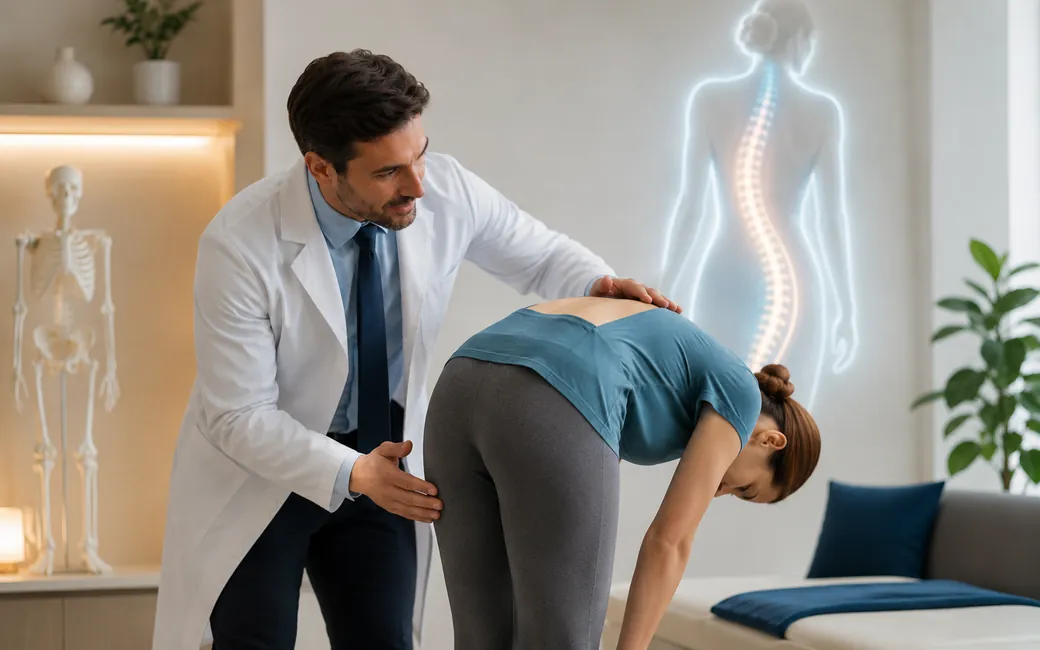 Adolescent Idiopathic ScoliosisMost common in growing children and teenagers — often noticed as uneven shoulders, waist asymmetry or a rib hump.Understand the curve →
🧓 Adult curve
Adolescent Idiopathic ScoliosisMost common in growing children and teenagers — often noticed as uneven shoulders, waist asymmetry or a rib hump.Understand the curve →
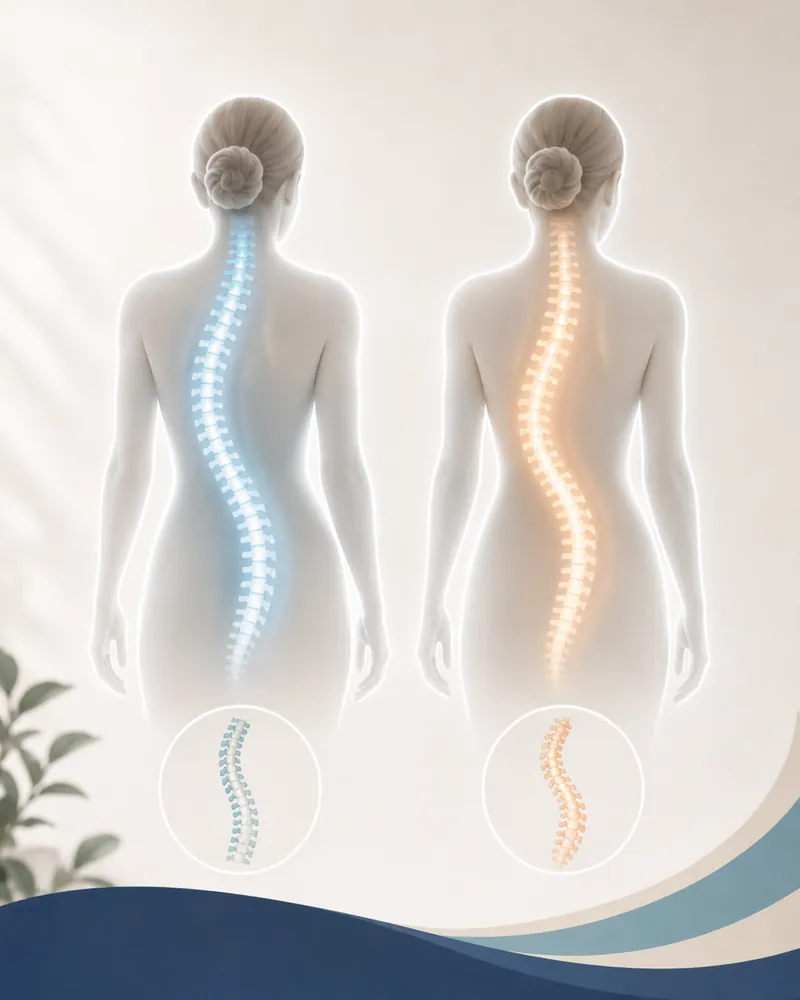
🧓 Adult curve Adult Degenerative ScoliosisA curve that develops or worsens with disc and facet joint wear — may cause back pain, imbalance or leg symptoms.Learn more →
🪑 Posture check
Adult Degenerative ScoliosisA curve that develops or worsens with disc and facet joint wear — may cause back pain, imbalance or leg symptoms.Learn more →
🪑 Posture check Postural Curve vs Structural CurveSome asymmetry is posture-related; true scoliosis is a structural curve that needs measurement on standing X-ray.Check posture →
📐 Curve planning
Postural Curve vs Structural CurveSome asymmetry is posture-related; true scoliosis is a structural curve that needs measurement on standing X-ray.Check posture →
📐 Curve planning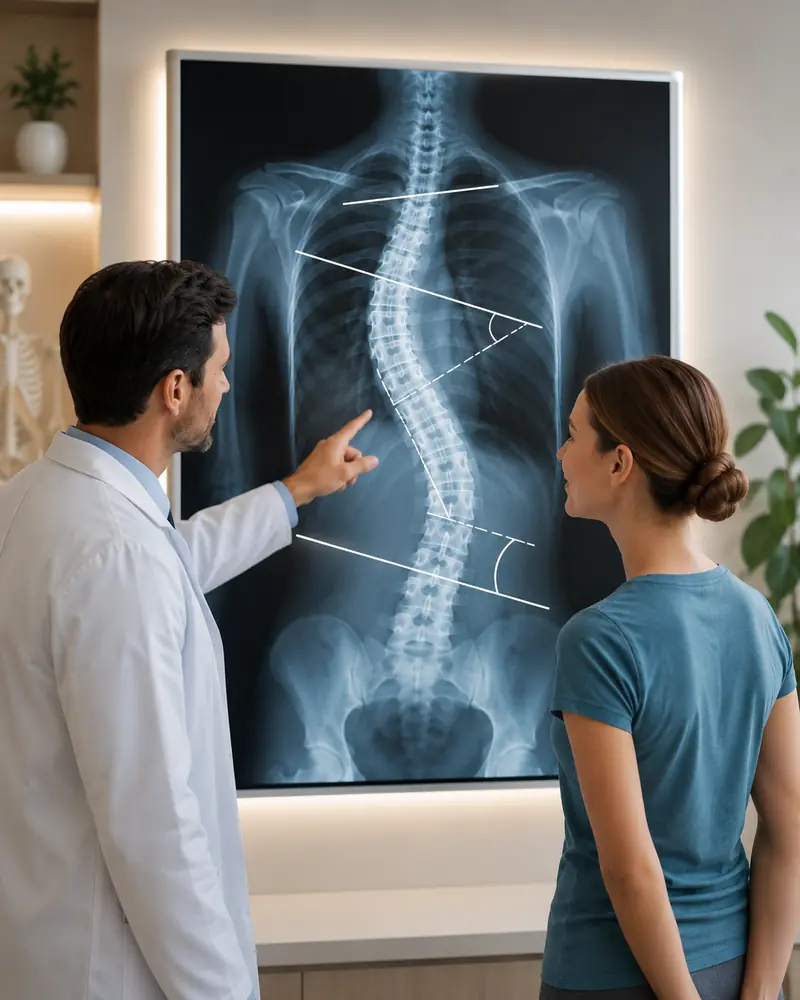 Spine Deformity AssessmentFor larger curves, sagittal imbalance, kyphosis or complex deformity — planning must be precise and individualised.Explore deformity care →
What Is Scoliosis?
Scoliosis is a sideways curve of the spine that measures at least 10° on a standing X-ray. The curve is usually three-dimensional: the spine bends sideways and also rotates, which is why a rib hump or one-sided back prominence may appear during the forward bend test.
In children and teenagers, the most important questions are: How big is the curve? How much growth is left? Is it progressing? In adults, the key questions are different: Is the curve causing pain, imbalance, nerve compression or walking difficulty?
Treatment is not based on the X-ray alone. A mild, stable curve may only need observation and exercises. A growing child with a moderate curve may benefit from bracing. A severe or progressive curve — especially with pain, imbalance or nerve symptoms — needs detailed deformity planning. 🙂
Scoliosis is measured on standing X-rays using the Cobb angle — the number helps guide observation, bracing or surgery.
Common Causes of Scoliosis
Many scoliosis curves have no single identifiable cause. The treatment plan depends on the type of curve, age, growth remaining and symptoms. 👆
Adolescent Idiopathic Scoliosis
The most common type in teenagers. It often appears during the growth spurt and may progress while growth remains.
Adult Degenerative Scoliosis
Disc and joint wear can create or worsen a curve in adulthood, causing back pain, imbalance or nerve narrowing.
Congenital Curves
Some curves come from vertebrae that formed differently before birth; these need early specialist evaluation.
Neuromuscular Causes
Muscle imbalance from neurological or muscular conditions can lead to progressive curves and sitting imbalance.
Postural or Functional Curve
Leg-length difference, pain guarding or posture habits can mimic scoliosis — examination separates this from a structural curve.
🧱Osteoporosis & Fracture
In older adults, vertebral fractures and disc collapse can worsen spinal alignment and create visible deformity.
🔥Back Pain Overlap
Back pain may come from the curve itself, but also from disc bulge, facet joints, stenosis or muscle fatigue.
🩻Imaging Correlation
X-rays measure the curve; MRI is added when pain, nerve signs, unusual patterns or surgical planning require more detail.
🧍 Posture signs
Uneven shoulders, waist asymmetry or clothes hanging unevenly can be the first clue.
📐 Forward bend test
A rib hump or one-sided back prominence suggests rotation of the spine.
🩻 Cobb angle
Standing X-rays help measure curve size and track progression accurately.
Scoliosis Symptoms — What Is Yours Telling You?
Scoliosis may be painless, cosmetic, painful or neurological depending on age and curve type. Match the pattern below. 👇
Uneven Shoulders
One shoulder blade or shoulder sits higher, or the head may look slightly off-centre over the pelvis.
Common first signRib Hump on Bending
A one-sided rib or back prominence during forward bend suggests spinal rotation, not just posture.
Structural clueClothes Fit Unevenly
One waist crease deeper, trouser length seeming unequal, or shirts twisting may point to trunk asymmetry.
Often noticed at homeBack Pain or Fatigue
Adults may feel low back ache, muscle tiredness, or difficulty standing and walking for long periods.
Adult patternLeg Pain or Numbness
Adult scoliosis can narrow nerve passages, causing sciatica-like leg pain, tingling or heaviness.
Nerve signLeaning Forward or Sideways
Visible imbalance, stooping or difficulty standing upright suggests a larger deformity needing detailed assessment.
Priority review💡 Tip: a child with visible asymmetry should be reviewed early, especially during the growth spurt — early bracing decisions can sometimes prevent progression.
When to See a Scoliosis Specialist in Chennai
Mild curves can be safely monitored, but these situations need timely spine specialist assessment. ⏱️
Curve appears to be increasing quickly
Visible asymmetry in a growing child or teenager
Rib hump or trunk shift on forward bending
Persistent back pain with a known curve
Leg pain, numbness, weakness or walking difficulty
New deformity or pain after a fall or injury
⏰ Early curve assessment matters
In growing children, the treatment window is tied to growth remaining. In adults, pain, imbalance and nerve symptoms decide urgency. Bring any standing spine X-rays or scan reports if available — or call +91 90809 68066 for guidance on what imaging is needed first.
Why Chennai Trusts Dr. Soma Sundar
Experienced hands, international training, and a philosophy that always starts with the least invasive treatment that can genuinely help you. View doctor profile.

15+ Years of Experience
Over fifteen years dedicated to spine and orthopaedic care, from everyday back pain to complex spinal conditions.
Internationally Trained
Fellowship training in Germany, Switzerland and the UK — FESS, FMISS, FAOS and the AO Spine Fellowship.
4.9 · 500+ Google Reviews
Consistently rated 4.9 by more than five hundred patients across both Chennai clinics.
FRCS & Gold Medallist
FRCS (Glasgow, UK) certified, MS Orthopaedics Gold Medallist, DNB and MNAMS qualified.
Non-Surgical First
Advanced pain management, injections and physiotherapy are always explored before surgery is considered.
Two Chennai Locations
Kauvery Hospital, Alwarpet (mornings) and Shens Hospital, Ashok Nagar (evenings) — six days a week.
How Scoliosis Is Diagnosed
Good scoliosis treatment begins with measuring the curve accurately, assessing growth remaining, and matching X-ray findings with symptoms and function.
Posture & Forward Bend Test 📐
Shoulder level, waist symmetry, trunk shift, rib hump and balance are checked carefully in standing and bending positions.
Standing Whole-Spine X-ray 🩻
Cobb angle, curve pattern, pelvic balance and side-view alignment are measured on standing films — not just a lying-down scan.
Growth & Progression Risk 🌱
In children and teenagers, skeletal maturity and growth remaining decide the risk of progression and need for bracing.
MRI When Needed 🔦
MRI is added for nerve symptoms, atypical curves, significant pain, abnormal examination or surgical planning.
Cobb angle measurement helps decide observation, bracing or surgery — but the patient matters more than the number alone.
Scoliosis Treatment Options — Stepwise and Safe
Treatment depends on age, curve size, curve progression, pain, balance and nerve symptoms. The aim is to avoid overtreatment while acting early when progression risk is real. ✅
Observe & Track 📈
Mild, stable curvesRegular clinical review and standing X-rays when appropriate to confirm the curve is not progressing.
- Cobb angle monitoring
- Growth assessment
- Posture and activity guidance
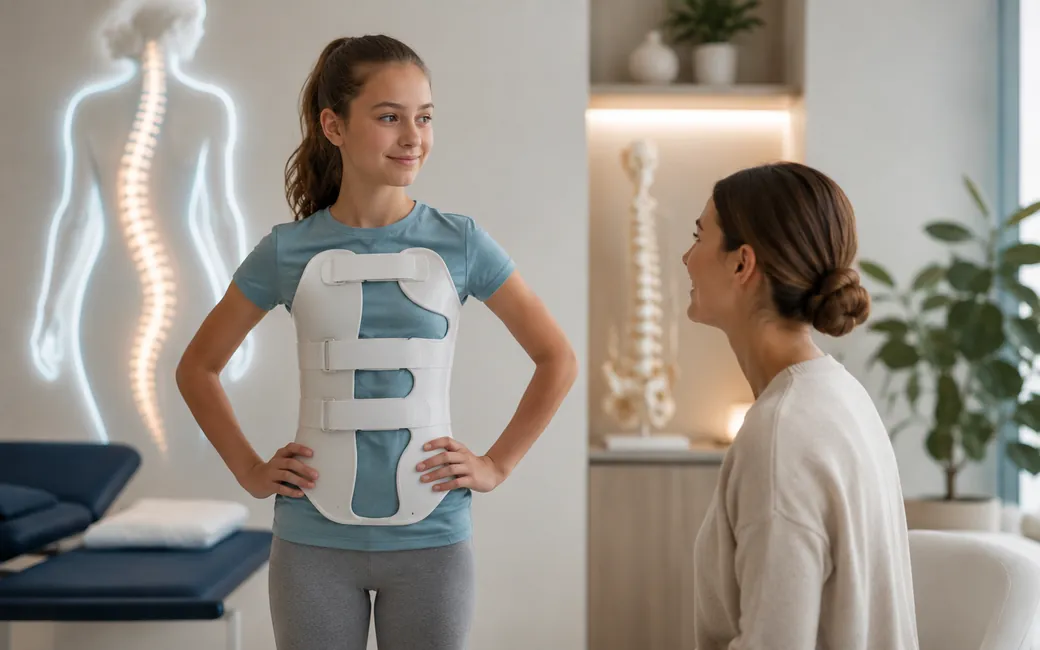
Brace When Growing 🧍
Selected moderate curvesBracing is considered in growing children when curve size and maturity suggest progression risk.
- Curve-pattern based brace plan
- Compliance counselling
- Follow-up X-ray schedule
Treat Pain Sources 🎯
Adult scoliosis pain carePhysiotherapy, medicines and targeted injections when pain comes from facet joints, nerves, discs or stenosis.
- Back pain and sciatica control
- Image-guided injections when suitable
- Walking and balance improvement
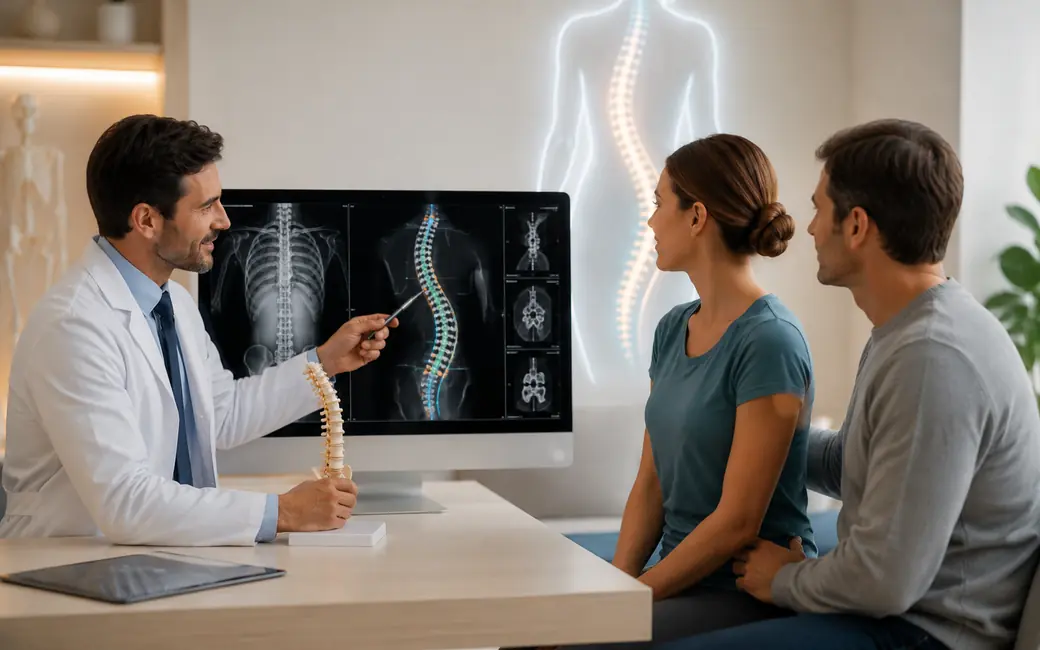
Correct When Needed 🔬
Selected severe or progressive curvesSurgery is reserved for clear indications — progression, severe deformity, imbalance, nerve compression or disabling pain.
- Detailed deformity planning
- Neurological safety focus
- Correction with stability
Physiotherapy & Exercises for Scoliosis
Exercises do not magically erase a structural curve, but they can improve posture, core strength, body awareness, breathing mechanics, pain and function. 👇
Scoliosis Exercises at Home
Patient-friendly routines for posture awareness, spinal mobility, core strength and safe daily movement.
🤸Spine Physiotherapy
Therapist-guided strengthening, balance work and pain-relief strategies for children, teens and adults.
🪑Posture Correction Physiotherapy
Useful for postural asymmetry, muscle imbalance, desk strain and adult scoliosis-related fatigue.
🔥Back Pain Care
When scoliosis is painful, the actual pain source — muscle, disc, facet or nerve — must be identified.
🩻Scan & X-ray Review
Understand your Cobb angle, curve pattern and MRI report before deciding treatment.
 🐈 Cat-cow mobility
 🐕 Bird-dog control
 🪲 Dead-bug core
 🌉 Glute bridge
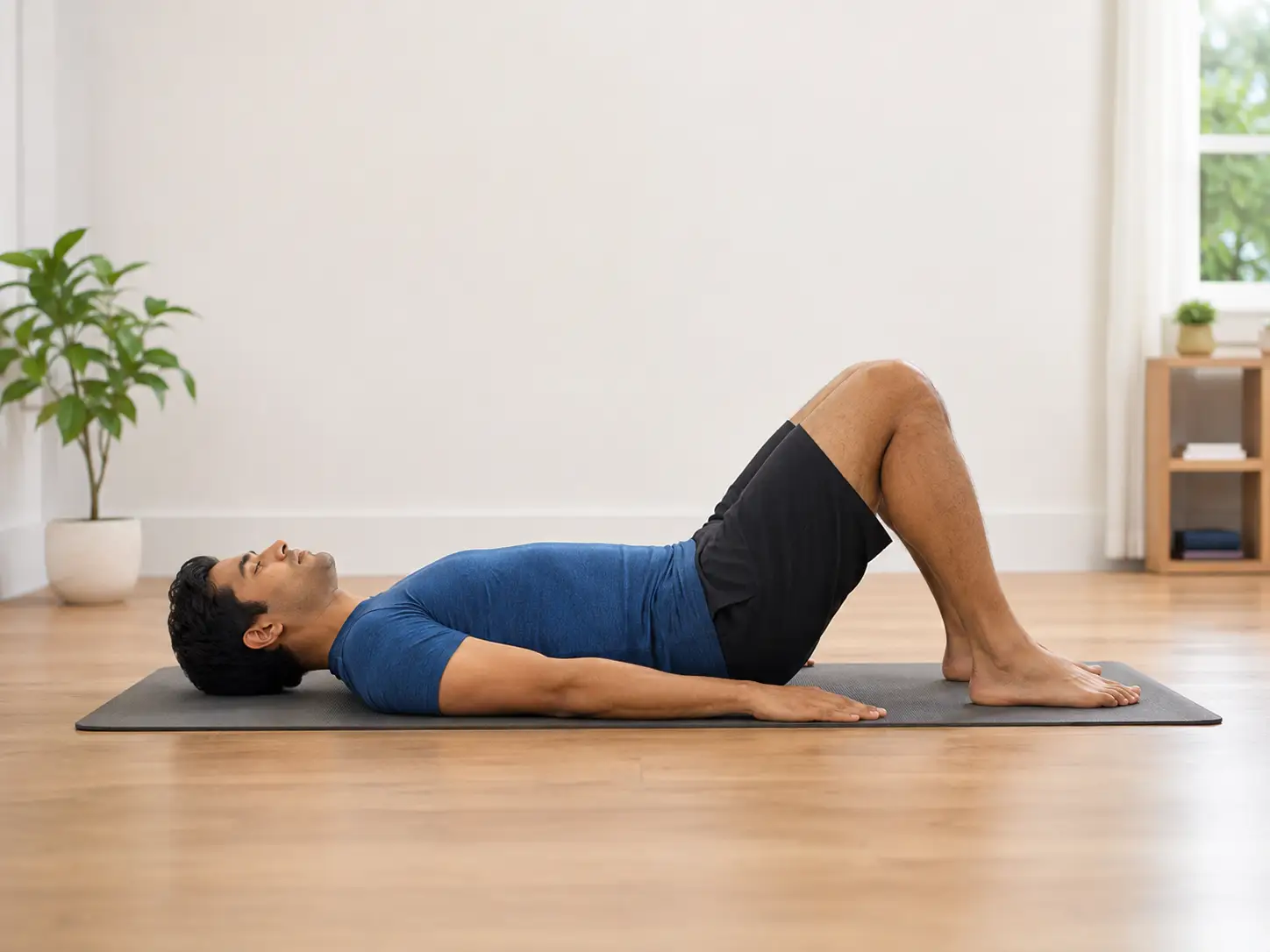 ↕️ Pelvic tilt🧍 Posture awareness
🏠 Home-visit physiotherapy is available across Chennai when travel is difficult.Useful for spine posture care, adult scoliosis pain, post-op rehab and supervised strengthening.
📞 Physio Home Visits · +91 98403 45335Scoliosis Bracing — When Is It Useful?
Bracing is mainly for growing children with curves at risk of progression — timing matters.
Bracing is not for every curve. It is most useful when a child or teenager is still growing and the curve is in a range where progression risk is meaningful. The goal is not cosmetic instant correction — it is to prevent the curve from worsening during growth. 🌱
The decision depends on Cobb angle, curve pattern, skeletal maturity, family commitment and follow-up X-rays. The brace must fit well, be worn as advised, and be combined with activity, posture and exercise guidance.
When Is Surgery Needed for Scoliosis?
Scoliosis surgery is considered only after careful assessment — typically for severe curves, progressive curves despite bracing, major trunk imbalance, disabling adult deformity pain, or nerve compression in adult scoliosis.
The aim is to correct the deformity safely, improve alignment, stabilise the spine and protect nerves. Planning includes standing full-spine X-rays, MRI when needed, bone quality assessment in adults, and a clear discussion about benefits, risks, recovery and realistic goals. 🤝
Reserved for clearly selected curves where progression, imbalance, pain or nerve safety is the priority.
⚖️ Balanced treatment principle
A curve on X-ray does not automatically mean surgery. Good scoliosis care means measuring correctly, tracking progression, protecting growth, treating pain generators, and choosing surgery only when the benefit clearly justifies it.
Scoliosis — Frequently Asked Questions
What Scoliosis Patients Say
My daughter’s shoulder asymmetry was noticed during school screening. Dr. Soma measured the curve, explained growth risk clearly and guided us on follow-up without creating panic.
★★★★★I had adult scoliosis with back pain and leg heaviness. The doctor separated curve pain from nerve compression and started a stepwise plan instead of jumping to surgery.
★★★★★The Cobb angle and X-ray were explained in simple language. We understood why bracing was advised and how often to review during growth.
★★★★★I was worried that scoliosis always means surgery. My curve was mild and stable, so I was advised exercises, posture care and periodic observation. Very reassuring.
★★★★★My mother had a bent posture and walking difficulty. Her adult deformity was assessed with standing X-rays and MRI, and the treatment plan was practical for her age.
★★★★★The physiotherapy plan focused on strength, balance and posture instead of random exercises. My back fatigue reduced and standing became easier.
★★★★★We consulted online from Coimbatore with X-ray photos shared earlier. The explanation was clear and we knew exactly what films to repeat and when.
★★★★★My curve had progressed and surgery was discussed only after detailed planning. The risks, goals and recovery were explained honestly before we decided.
★★★★★I liked that the consultation focused on function, confidence and long-term monitoring — not just the curve number on the X-ray.
★★★★★Explore More Spine Care
Expert Spine Advice, From Wherever You Are
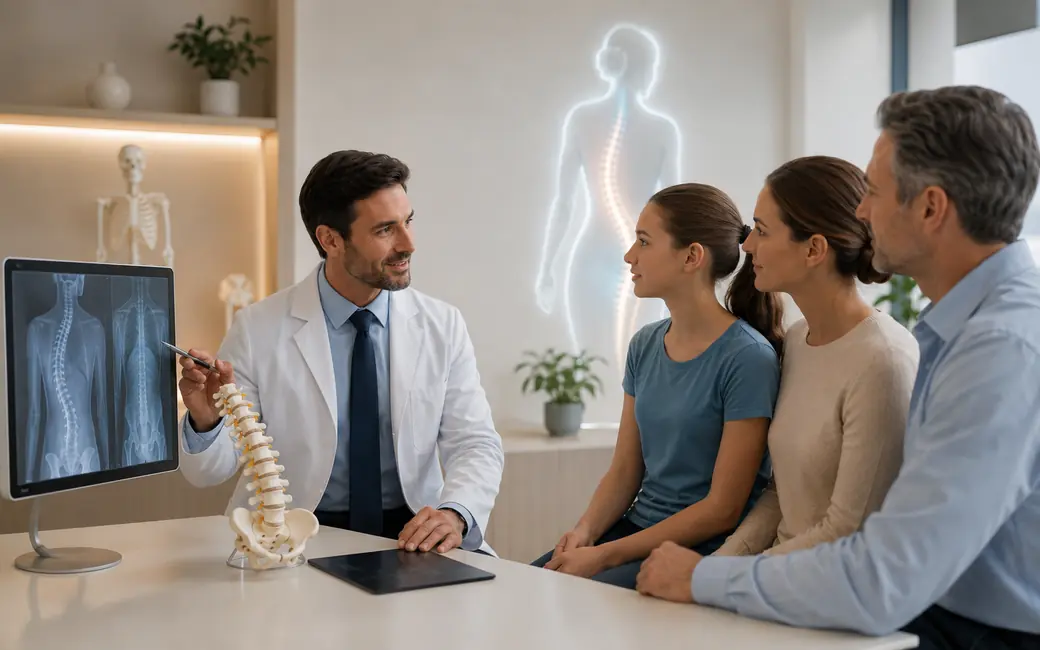
Can’t travel to Chennai, or want a specialist opinion before deciding your next step? Consult Dr. Soma Sundar over a secure video call — and let your whole family join and ask questions.

-
Consult from anywhere
Connect from home, another city, or abroad — no travel needed for an expert opinion.
-
Reports & MRI — optional
You can share scans in advance on WhatsApp if you have them, or simply talk first. Both work.
-
Clear next steps
Leave the call knowing what your condition is, what to try first, and when a clinic visit is truly needed.
Book a Video Consultation
Message us on WhatsApp with your name and a short note about your problem — our team will confirm a convenient slot.
Especially useful for- Outstation and overseas patients — and their families
- A second opinion before agreeing to spine surgery
- Understanding an MRI or scan report in plain language
- Follow-up reviews after surgery or injections
- Elderly patients who find travelling difficult
📎 Sending scans or MRI in advance is optional — many patients simply describe their problem and share reports later if needed.
Explore SundarSpine
Everything on this site, organised the way patients think — conditions, treatments, physiotherapy, home exercises and free resources.