Spine Health · Home Exercise Guide
Neck Pain Exercises You Can Do Safely at Home
If your neck feels stiff, aching, posture-related, or painful after long hours at a desk or mobile phone use, the right gentle movement can help you regain comfort and confidence. Here are eight safe, doctor-approved neck exercises, with step-by-step guidance from Chennai orthopaedic and pain specialist Dr. Soma Sundar S.
Start the Exercises ↓
📞 Book Appointment

Gentle mobility, posture correction and strengthening form the foundation of recovery for many common neck pain problems.
A Mobile, Well-Supported Neck Hurts Less
For many people with neck pain, the problem is not just the cervical joints. It is often a combination of stiffness, poor posture, tight upper trapezius muscles, weak postural support muscles and long hours of screen use. Gentle movement improves mobility, while stretching and strengthening reduce how often pain returns.
This is a general starter routine. If you have cervical spondylosis, a slipped disc, radiating arm pain or significant dizziness, your plan may need adjustments. Use the warning signs below and get assessed if you are unsure.
1
Start gentle
Use small mobility exercises and stretches to reduce stiffness and ease muscle tightness.
2
Build support
Add chin tucks, scapular work and gentle isometrics to support the neck better.
3
Stay consistent
Short daily practice usually works better than waiting for pain to become severe again.

Good neck recovery usually combines mobility, muscle relaxation and gradual strengthening — not prolonged rest.
Six Simple Ground Rules
Follow these and you’ll get the benefit safely. The single most important rule: work in a comfortable range — never sharp pain.
🟢
Hurt vs. harm
A mild stretch or muscle-working feeling is safe. Sharp pain, numbness, dizziness or radiating symptoms are your signal to stop.
🪑
Good posture helps
Try doing these exercises while sitting upright with relaxed shoulders, rather than slumping forward.
🫁
Keep breathing
Breathe normally throughout. Slow and controlled beats fast and forced.
🔁
Consistency beats intensity
A few minutes daily works far better than one long, tiring session.
📵
Reduce strain triggers
Take breaks from mobile phone use, laptop work and poor sleeping posture while doing this program.
🩺
When in doubt, ask
Arm pain, hand numbness, severe headaches, imbalance or persistent night pain deserve proper assessment before exercise.
8 Neck Pain Exercises, Step by Step
Work through the gentle mobility and stretching exercises first. Then add postural strengthening and isometric work to better support your neck in daily life.
Phase 1
Mobility & Stretching
Ease stiffness, relax tight muscles and improve neck movement in a safe, gentle way.
Chin Tuck
🎯 Posture & deep neck supportGentle 5shold10repsdailyfrequency1Sit or stand tall with your eyes looking straight ahead.2Gently draw your chin backwards, as if making a double chin.3Keep the head level; do not look down.4Hold briefly, then relax.💡
This helps counter forward-head posture from long screen time.
⚠️
Avoid forcing the movement or poking the chin downwards.
Side-Bend Stretch
🎯 Upper trapezius stretchGentle 15–20shold3each sidedailyfrequency1Sit upright with relaxed shoulders.2Gently tilt one ear towards the same-side shoulder.3You may use your hand lightly to deepen the stretch.4Hold, then repeat on the other side.💡
Keep the opposite shoulder relaxed and down for a better stretch.
⚠️
Do not yank the head or hold your breath.
Gentle Neck Rotation
🎯 Turning mobilityGentle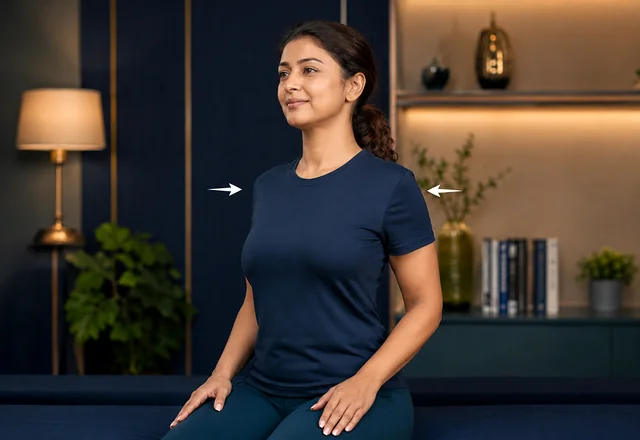 8–10reps2×setsdailyfrequency1Sit upright and keep the shoulders relaxed.2Slowly turn your head to look over one shoulder.3Pause at a comfortable point without forcing the movement.4Return to the middle and repeat to the other side.💡
Useful if turning to drive or look sideways feels stiff.
⚠️
Stop if rotation causes dizziness, arm pain or sharp pain.
Levator Scapulae Stretch
🎯 Back of neck and shoulder stretchGentle 15–20shold3each sidedailyfrequency1Sit upright and gently turn your face about 45 degrees away from the painful side.2Look down towards your armpit.3Use the hand on the same side to apply a light stretch.4Hold, then relax and repeat on the other side.💡
This often feels especially good for desk-related neck and shoulder tightness.
⚠️
Keep the stretch gentle. Do not force the head into pain.
Phase 2
Postural Strength & Isometrics
Add these once Phase 1 feels comfortable. They help support the neck in sitting, working and daily life.
Shoulder Rolls
🎯 Muscle relaxationGentle 10reps2×setsdailyfrequency1Sit or stand comfortably.2Lift both shoulders upwards.3Roll them back and then gently down.4Repeat slowly in a smooth circular movement.💡
Great during work breaks when your shoulders feel tense and elevated.
⚠️
Keep the movement smooth rather than fast.
Scapular Squeeze
🎯 Posture supportModerate 5shold10reps3–4×weekly1Sit or stand tall with arms relaxed by your side.2Gently draw your shoulder blades back and slightly down.3Keep the neck relaxed and avoid shrugging.4Hold briefly, then relax.💡
Strong shoulder-blade support often reduces recurrent neck strain.
⚠️
Do not arch the low back or over-squeeze aggressively.
Neck Flexion Isometric
🎯 Front neck supportModerate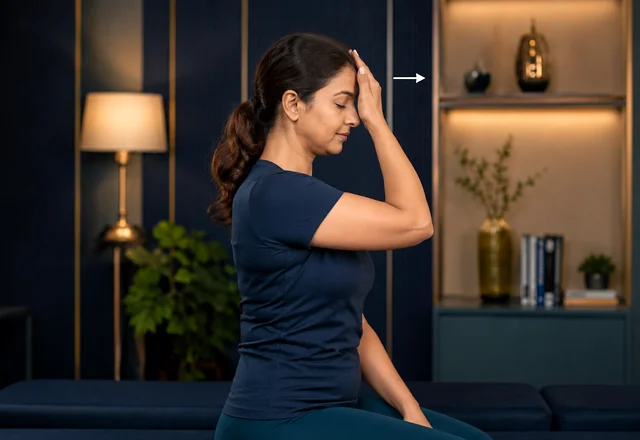 5shold8–10reps3×weekly1Place your palm against your forehead.2Gently press your head forward into your hand without actually moving the neck.3Keep the effort light and controlled.4Hold briefly, then relax.💡
Isometrics strengthen the neck without big movements, which many people find comfortable.
⚠️
Use only gentle resistance. Do not strain or hold your breath.
Neck Side-Bend Isometric
🎯 Side support strengthModerate 5shold8–10each side3×weekly1Place your right hand against the right side of your head.2Gently press your head into your hand as if side-bending, but do not allow actual movement.3Keep the effort light and the shoulders relaxed.4Repeat on the other side.💡
This strengthens the side muscles that help support your neck during daily activity.
⚠️
Stop if you feel arm tingling, headache or dizziness.
⏱️
Don’t Forget Posture Breaks
Every 30–45 minutes, change your position, roll your shoulders, sit tall and look away from the screen. Frequent small posture breaks are one of the simplest ways to prevent neck pain from returning.
Your Day, At a Glance
Not sure how it all fits together? Here’s a simple daily flow that brings the eight exercises above into one easy routine.
1Reset postureSit upright, relax the shoulders and take a few slow breaths1 min
2Phase 1: MobilityChin Tuck, Side-Bend Stretch, Gentle Rotation, Levator Scapulae Stretch6–8 min
3Phase 2: StrengthShoulder Rolls, Scapular Squeeze, Neck Flexion Isometric, Neck Side-Bend Isometric5–6 min
4Repeat posture breaksShort movement breaks during work or screen timeAll day
A Simple Weekly Routine
You don’t need a gym or a lot of time — just a clear, repeatable plan. Adjust based on pain, stiffness and daily activity.
📅Every Day
Chin tucks, stretching and posture breaks. These help prevent the neck from stiffening up again.
💪3–4× a Week
Scapular squeeze and isometric strengthening. Leave a rest day between harder strengthening if the muscles feel sore.
📈Every 1–2 Weeks
Progress gently — add a few reps or hold a little longer only if pain stays controlled.
What’s Behind Your Neck Pain?
Neck pain has many possible causes — from posture-related muscle tension to disc-related nerve irritation. These are common conditions where exercises may help, but the plan may differ.
🧠General Neck Pain
Stiffness, posture-related pain and muscle tension that often responds well to exercise and posture correction.
🦴Cervical Spondylosis
Age-related wear changes in the neck that can lead to stiffness, pain and reduced movement.
💿Cervical Disc Bulge
Disc irritation can cause neck pain with or without pain radiating into the shoulder or arm.
⚡Cervical Radiculopathy
Nerve irritation leading to neck pain with arm pain, tingling or numbness.
🚨Cervical Myelopathy
A more serious spinal cord-related problem that needs specialist assessment, not just home exercise.
🏃Neck Physiotherapy
Structured rehabilitation to improve mobility, posture and symptom control.
Learn more →
When to Stop and See a Doctor
Exercises help many common neck problems — but some symptoms need proper medical assessment rather than self-treatment. Pause your routine and arrange to be seen if any of the following apply.
⚡
Arm pain, tingling or numbness
These may suggest nerve irritation rather than a simple muscle strain.
🤕
Pain after a fall or injury
New pain after trauma should be assessed before self-exercising.
🌙
Night pain or worsening headaches
Persistent night pain or unusual headaches deserve further evaluation.
🚶
Imbalance or hand clumsiness
Difficulty with walking balance or hand coordination may suggest spinal cord involvement.
🚨
Seek medical care promptly if you have:
Severe arm pain, progressive weakness, hand numbness, walking imbalance, loss of bladder control, fever, major trauma, or rapidly worsening symptoms. These need proper assessment rather than self-exercise alone.
If exercises alone aren’t enough, there is a clear path forward — from structured neck physiotherapy to medications, ergonomic correction, or selected image-guided injections when appropriate.
Why Choose Dr. Soma Sundar S?
Dr. Soma Sundar S sees neck pain across the full spectrum — from posture-related pain and cervical spondylosis to disc-related nerve pain and the selected problems that need advanced treatment. That balanced view is why his first focus is usually movement, rehabilitation and non-surgical recovery.
14+ Years Experience
Gold Medallist
FRCS (Tr & Orth) UK
Pain Management Specialist
🎓
Internationally Trained Orthopaedic Specialist
MBBS, MS (Ortho), FRCS (Tr & Orth) UK, FISS, FESS (Germany) and FMISS (Switzerland) — bringing structured, modern care to Chennai.
🤝
Conservative-First Philosophy
Exercise, ergonomic correction, physiotherapy and targeted pain-relief treatments are considered before surgery whenever safe and appropriate.
💉
Advanced Pain Management Options
Selected injections and precise diagnosis can help calm pain and make rehabilitation more comfortable in the right patient.
⭐
Trusted Across Chennai
A 4.9★ rating from 410+ verified Google reviews, built on consistent, honest results over 14+ years.

4.9★410+ Reviews
Neck Pain Exercises — Your Questions Answered
Yes, these are gentle exercises commonly used for posture-related neck pain and stiffness. Work only in a comfortable range. If you have arm numbness, severe headache, trauma or imbalance, get assessed before starting.
Do the gentle mobility and stretching exercises daily. Strengthening and isometric work can usually be done three to four times a week.
Usually yes, gently. Small movements and stretches often help more than complete rest. Avoid aggressive strengthening until the flare settles.
Many people notice less stiffness within one to two weeks. Better muscle support and fewer recurrences usually take four to eight weeks of regular practice.
A mild stretch or muscle-working feeling is normal. Sharp pain, tingling, dizziness or worsening arm symptoms are not. Ease off if these occur.
Often yes. Gentle mobility, stretching and postural strengthening are commonly recommended. The exact plan may need adjustment depending on whether there is nerve irritation.
Possibly, but with caution. Radiating arm pain can suggest a nerve-related problem. If exercises worsen pain down the arm, stop and get assessed.
No gym is needed. These exercises can be done with just a chair or wall and your own body weight.
Stop the painful exercise and return to gentler mobility work. If pain, arm tingling or headaches remain worse the next day, reduce the program and seek advice.
See a doctor if neck pain lasts more than two to four weeks, recurs frequently, follows trauma, causes arm symptoms, or disturbs sleep.
Dr. Soma Sundar S is a Chennai-based spine, orthopaedic and pain specialist who treats neck pain with exercise, physiotherapy, ergonomic correction and targeted pain-relief options when needed.
For many people, yes. Most common neck pain problems improve with proper exercise, physiotherapy and activity modification. Surgery is considered only for selected cases.
How the Right Exercises Helped Our Patients
G4.9/5from 410+ Google Reviews
“
My neck used to feel stiff every evening after laptop work. The chin tuck and stretching routine was simple and practical. Within a couple of weeks, my neck felt much freer and less tired.
★★★★★RRamesh K.Desk job neck pain
“
I thought rest was enough, but the stiffness kept coming back. Dr. Soma Sundar explained how posture and muscle weakness were part of the problem. The exercises made a big difference.
★★★★★LLakshmi P.Recurrent neck pain
“
The side-bend stretch and levator stretch were especially helpful for my upper trapezius tightness. I also started taking posture breaks at work, and that reduced my pain a lot.
★★★★★NNivetha S.Posture-related neck strain
“
The video consultation helped me understand which exercises were safe and which movements to avoid. I liked that the plan was gentle, realistic and easy to follow at home.
★★★★★DDeepa M.Home-based neck rehabilitation
“
I used to get neck pain and headaches after long phone use. The combination of chin tucks, shoulder rolls and scapular squeeze helped reduce the strain. It made daily work much easier.
★★★★★AArun V.Screen-related neck pain
“
I was worried about cervical spondylosis, but Dr. Soma Sundar explained that the right exercises and posture changes could still help a lot. The routine made my neck feel stronger and less stiff.
★★★★★SSujatha R.Cervical spondylosis symptoms
Neck Pain Home Exercise Guide
Download the complete Neck Pain Home Exercise Guide as a free, printable PDF — every exercise, step and rep count in one handy page you can keep on your phone or print at home. No sign-up required.
Download Free PDFNeck Pain Home Exercise Guide · PDF · Free · Printable
Video Consultation Available
Not sure which neck exercises are safe for you? Or want to discuss your scan, pain pattern or arm symptoms before visiting? Dr. Soma Sundar S offers secure video consultations — bringing the same expertise directly to you.
Simply share your reports in advance. Dr. Soma Sundar will review them before your call and provide a clear, personalised plan — including exercises, ergonomic advice, physiotherapy and whether you need an in-person visit.
📋Share your reports in advanceSend X-ray, MRI, old prescriptions or clinical notes before the call for a focused consultation🩺Expert opinion, clear planReceive a diagnosis, exercise plan and honest treatment recommendation💉Injection advice when neededUnderstand whether you need further imaging, physiotherapy or a pain-relief procedure⏱Flexible timingEvening slots available to suit working professionals and outstation patients💬 WhatsApp to Book Video Call📞 Call to Book Dr. Soma Sundar SMBBS · MS (Ortho) · FRCS UK · FMISSAvailable for video consultation1WhatsApp or call to schedule2Share your scan / reports3Join video call at agreed time4Receive your personalised neck planSecure & confidential. Reports shared via WhatsApp stay private.
Neck Pain Learning Hub
More home exercise guides, related neck conditions and treatment options for a complete picture of neck pain care.
🏃 Home Exercise Guides
Low Back Pain Exercises
Neck Pain Exercises
Knee Pain Exercises
🧠 Neck Conditions
Neck Pain
Cervical Spondylosis
Cervical Radiculopathy
💉 Treatments
Neck Physiotherapy
Cervical Disc Bulge
Cervical Myelopathy
📅 Appointments
About Dr. Soma Sundar
All Spine Conditions
Book an Appointment