Foot & Ankle Health · Home Exercise Guide
Ankle Pain Exercises You Can Do Safely at Home
If your ankle is painful, stiff, swollen after activity, or still weak after a sprain, the right gentle movement can help you regain comfort and confidence. Here are eight safe, doctor-approved ankle exercises, with step-by-step guidance from Chennai orthopaedic and pain specialist Dr. Soma Sundar S.
Start the Exercises ↓
📞 Book Appointment

Gentle ankle mobility, strengthening and balance work forms the foundation of recovery after many ankle injuries.
Strong, Mobile Ankles Recover Better
For many people with ankle pain, the problem is not just the injured ligament or stiff joint — it is the loss of movement, calf flexibility, strength and balance that follows. Gentle ankle exercises improve mobility, restore muscle control and reduce the chance of repeated sprains.
This is a general starter routine. If you have an acute ankle sprain, chronic instability, Achilles tightness or difficulty bearing weight, your plan may need adjustments. Use the warning signs below and get assessed if you are unsure.
1
Start gentle
Use ankle pumps, circles and alphabet movements to ease stiffness and reduce swelling.
2
Build strength
Add calf stretching, resistance exercises and heel raises to support the ankle properly.
3
Retrain balance
Simple single-leg balance work helps your ankle feel stable and more confident in daily life.

Good ankle recovery follows a simple path: mobility, strength, balance and then a gradual return to walking and activity.
Six Simple Ground Rules
Follow these and you’ll get the benefit safely. The single most important rule: work in a comfortable range — never sharp pain.
🟢
Hurt vs. harm
A mild stretch or muscle-working feeling is safe. Sharp pain, giving way or increasing swelling is your signal to stop.
🧊
Acute sprain? Start gently
If the ankle is freshly sprained, begin with pumps, circles and elevation before progressing further.
🫁
Keep breathing
Breathe normally throughout. Slow and controlled beats fast and forced.
🔁
Consistency beats intensity
A little every day works far better than one long, tiring session.
🧍
Use support for balance
For standing exercises, keep a wall, chair or counter nearby so you feel secure.
🩺
When in doubt, ask
Persistent swelling, major bruising, inability to bear weight or repeated sprains deserve proper assessment before exercise.
8 Ankle Pain Exercises, Step by Step
Work through the gentle mobility exercises first. When these feel comfortable, add strengthening and balance drills to improve walking confidence and reduce the risk of another sprain.
Phase 1
Mobility & Early Recovery
Ease stiffness, improve ankle motion and wake up the muscles after a sprain or pain flare-up.
Ankle Pumps
🎯 Ankle mobility & swelling controlGentle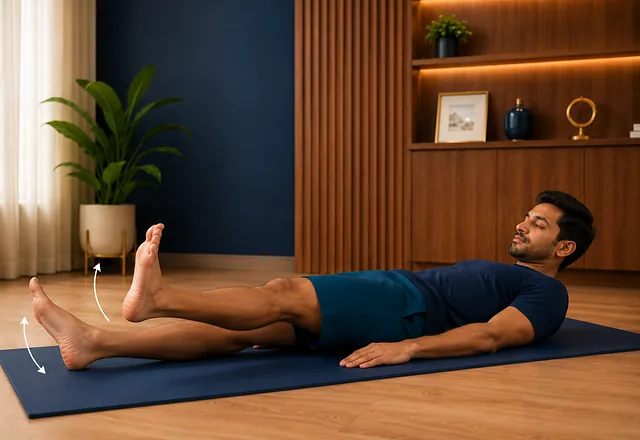 15–20reps2–3×setsdailyfrequency1Sit or lie with your leg supported and relaxed.2Point your foot away from you slowly.3Then pull your toes back towards you.4Repeat in a slow, comfortable rhythm.💡
Excellent as an early exercise after a sprain or when swelling makes the ankle feel stiff.
⚠️
Stay in a pain-free range. Do not force the ankle if movement is sharply painful.
Ankle Circles
🎯 Joint mobilityGentle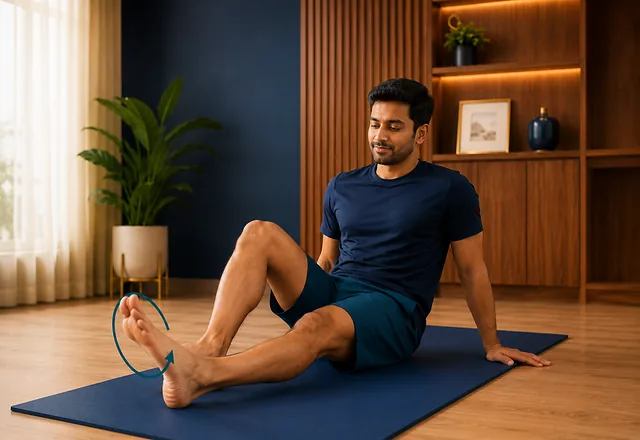 10each way2×setsdailyfrequency1Sit comfortably with your foot lifted off the floor.2Move the foot in slow circles clockwise.3Make the circles as smooth as you can.4Repeat anticlockwise.💡
Think of drawing neat circles with your toes. Smooth motion matters more than circle size.
⚠️
Reduce the size of the circle if you feel pinching or pain at the outer ankle.
Ankle Alphabet
🎯 Controlled motion in many directionsGentle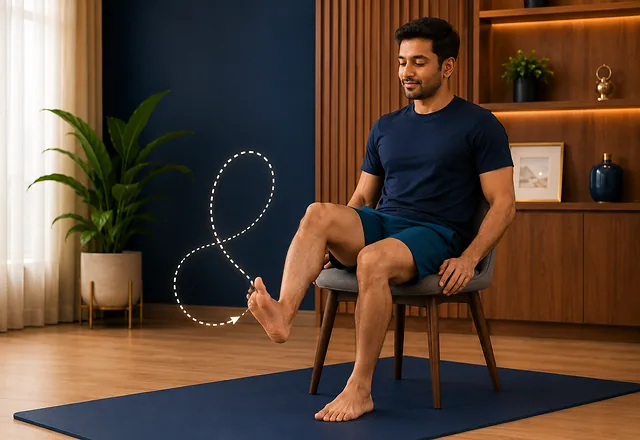 A–Zonce1–2×roundsdailyfrequency1Sit with your leg supported and foot free in the air.2Imagine a pen under your big toe.3Slowly draw the letters of the alphabet in the air.4Use smooth, controlled movements rather than fast scribbling.💡
This is a great way to move the ankle in many directions without overthinking it.
⚠️
If the full alphabet feels too much, start with A to H and build up.
Towel Scrunch
🎯 Foot & arch muscle activationGentle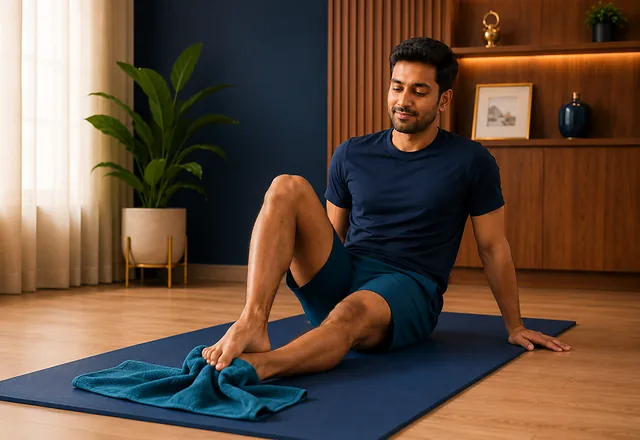 8–12reps2×sets3–4×weekly1Place a small towel flat on the floor while seated.2Put your foot on the towel.3Use your toes to scrunch the towel towards you.4Relax and repeat, keeping your heel down.💡
This gently works the small foot muscles that help support the ankle and arch.
⚠️
If you have toe cramps, pause and shake the foot out before continuing.
Phase 2
Strength & Balance
Add these once the ankle feels less irritable. They improve calf flexibility, support strength and stability.
Wall Calf Stretch
🎯 Calf flexibility & ankle bendingGentle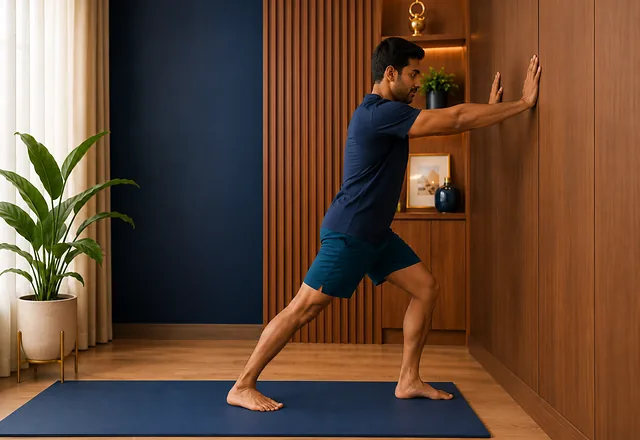 20–30shold3repsdailyfrequency1Stand facing a wall with your hands supported.2Place the affected leg behind you with the heel flat.3Lean forward until you feel a stretch in the calf.4Hold, then relax and repeat.💡
Keep the back heel down. A tight calf often limits ankle mobility and changes walking mechanics.
⚠️
Do not bounce. Stretch only to a comfortable pull.
Resistance Band Ankle Strengthening
🎯 Ankle strength in multiple directionsModerate 10–12reps2×sets3×weekly1Sit with your leg outstretched and a light resistance band around the forefoot.2Move the foot slowly against the band resistance.3Work in the direction advised — up, down, in or out.4Return slowly with control.💡
Start with the lightest band. Control on the return phase is just as important as pushing out.
⚠️
Avoid strong resistance if the ankle is still very swollen or painful.
Supported Single-Leg Balance
🎯 Proprioception & ankle stabilityModerate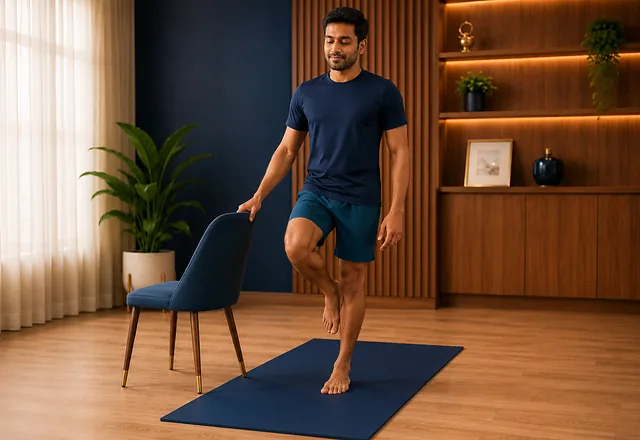 20–30shold3repsdailypractice1Stand near a wall or chair for support.2Lift the opposite foot and balance on the affected leg.3Use one fingertip or a hand for support as needed.4Hold, rest, then repeat.💡
Balance training is one of the best ways to reduce repeated ankle sprains.
⚠️
Never do this unsupported if you feel unsteady.
Double-Leg Heel Raise
🎯 Calf strength & push-off supportModerate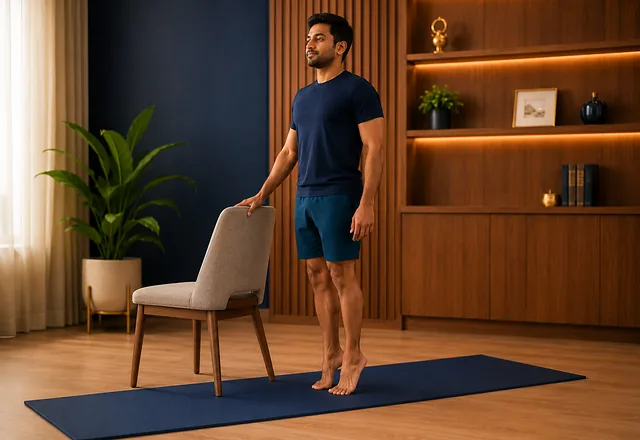 10–15reps2×sets3–4×weekly1Stand holding a chair, wall or counter.2Slowly rise up onto your toes.3Pause briefly at the top.4Lower your heels back down with control.💡
This builds calf strength, which is important for walking, stairs and a stable push-off.
⚠️
If the exercise causes sharp Achilles or ankle pain, reduce the height or stop.
🚶
Short, Comfortable Walking Still Matters
Once the initial pain settles, a little walking on level ground helps restore confidence and a more normal gait. Start small and increase slowly.
Your Day, At a Glance
Not sure how it all fits together? Here’s a simple daily flow that brings the eight exercises above into one easy routine.
1Warm UpElevate the leg briefly, then do ankle pumps and a few comfortable steps around the room1–2 min
2Phase 1: MobilityAnkle Pumps, Ankle Circles, Ankle Alphabet, Towel Scrunch5–7 min
3Phase 2: Strength & BalanceWall Calf Stretch, Band Strengthening, Single-Leg Balance, Heel Raise6–8 min
4Walking PracticeShort, comfortable walking on level ground5–15 min
A Simple Weekly Routine
You don’t need a gym or a lot of time — just a clear, repeatable plan. Adjust based on pain, swelling and walking comfort.
📅Every Day
Ankle pumps, ankle circles, gentle calf stretching and short flat-ground walks. These keep the ankle from stiffening up.
💪3–4× a Week
Resistance band work, heel raises and supported balance training. Leave a rest day in between if the ankle feels sore.
📈Every 1–2 Weeks
Progress gently — add reps, hold time, or a little more walking only if swelling and pain stay controlled.
What’s Behind Your Ankle Pain?
Ankle pain has many possible causes — from a simple sprain to tendon irritation or chronic instability. These are common conditions where exercise may help, but the plan may differ.
🤕Ankle Sprain
Twisting injury with pain, swelling and difficulty walking.
🧍Chronic Ankle Instability
Repeated sprains, giving-way episodes and reduced confidence on uneven ground.
🦶Achilles Tendon Pain
Pain or tightness behind the ankle, especially with walking, stairs or sports.
🦴Heel Pain
Foot and ankle mechanics can overlap, especially when pain alters your walking pattern.
🌅Plantar Fasciitis
Morning heel pain often benefits from calf flexibility, foot exercises and load management.
🏃Ankle Physiotherapy
Structured rehabilitation to restore strength, balance and return-to-activity confidence.
Learn more →
When to Stop and See a Doctor
Exercises help many ankle problems — but some symptoms need proper medical assessment rather than self-treatment. Pause your routine and arrange to be seen if any of the following apply.
💧
Persistent swelling
If swelling keeps returning or does not settle, the ankle may need diagnosis-specific treatment.
🚫
Unable to bear weight
Struggling to walk or put weight through the foot after injury deserves prompt evaluation.
🧍
Repeated giving way
The ankle repeatedly turning or feeling unstable can suggest ligament weakness or chronic instability.
💥
Pain after a major twist or fall
Major bruising, deformity or a popping sensation after injury should be checked before self-exercising.
🚨
Seek medical care promptly if you have:
Severe swelling, inability to bear weight, a visibly deformed ankle, numbness, calf swelling, fever, or pain after a major injury. These need proper assessment rather than self-exercise alone.
If exercises alone aren’t enough, there is a clear path forward — from structured ankle physiotherapy to supportive bracing, pain-relief medication, or further imaging when needed.
Why Choose Dr. Soma Sundar S?
Dr. Soma Sundar S sees ankle pain across the full spectrum — simple exercise-responsive pain, frozen shoulder that improves with injection care, and selected tendon injuries that need surgical referral. That balanced view is why his first focus is usually movement, rehabilitation and non-surgical recovery.
14+ Years ExperienceGold MedallistFRCS (Tr & Orth) UKPain Management Specialist🎓
Internationally Trained Orthopaedic Specialist
MBBS, MS (Ortho), FRCS (Tr & Orth) UK, FISS, FESS (Germany) and FMISS (Switzerland) — bringing structured, modern care to Chennai.
🤝
Conservative-First Philosophy
Exercise, physiotherapy and targeted injections are considered before surgery whenever safe and appropriate.
💉
Advanced Pain Management Options
Selected shoulder injections can calm pain quickly and make exercises easier, especially in frozen shoulder and painful inflammation.
⭐
Trusted Across Chennai
A 4.9★ rating from 410+ verified Google reviews, built on consistent, honest results over 14+ years.
 4.9★410+ Reviews
Ankle Pain Exercises — Your Questions Answered
Yes, these are gentle exercises commonly used for ankle pain, ankle sprain recovery and ankle stiffness. Work only in a comfortable range. If you cannot bear weight, have a major injury, deformity or numbness, get assessed before starting.
Do the gentle mobility exercises daily. Strengthening and balance work can usually be done three to four times a week, depending on soreness and swelling.
Usually yes, gently. Start with ankle pumps, circles and elevation-friendly exercises. Avoid aggressive strengthening until swelling settles and weight-bearing is comfortable.
Many people notice less stiffness within one to two weeks. Strength, balance and confidence usually improve over four to eight weeks with regular practice.
A mild stretch or muscle-working feeling is normal. Sharp pain, increased swelling, a sense of giving way or lingering pain the next day means you should ease off.
Yes, many of these are especially useful after an ankle sprain. Start with pumps, circles and the alphabet, then progress to strengthening and balance as pain settles.
No gym is needed. A towel, wall or chair is enough to begin. A light resistance band is helpful later for ankle strengthening but is not essential at the start.
That is common. Start with fingertip support against a wall or chair. Even supported single-leg balance gives the ankle excellent training.
Stop the painful exercise and go back to the gentler mobility drills. If the ankle remains worse the next day, reduce reps and range. Persistent worsening or swelling needs a review.
See a doctor if ankle pain lasts more than two to four weeks, if you have repeated sprains, marked swelling, inability to bear weight, or pain after a major injury.
Dr. Soma Sundar S is a Chennai-based spine, orthopaedic and pain specialist who treats ankle pain with exercise, rehabilitation, bracing advice and non-surgical care, with referral for surgery only when truly necessary.
Yes. Strengthening and especially balance training are among the best ways to reduce repeated ankle sprains and improve walking confidence.
How the Right Exercises Helped Our Patients
“
I kept spraining my ankle again and again. Dr. Soma Sundar explained why balance training was important. The supported single-leg balance and band exercises made a big difference. I finally feel more confident while walking outside.
★★★★★PPriya RamanHomemaker, AdyarRepeated Ankle Sprain“
After a bad twist, my ankle stayed stiff and swollen for weeks. The ankle pumps, circles and alphabet exercise were very simple to follow. I liked that the plan started gently and then slowly progressed to strengthening.
★★★★★KKarthik SIT Professional, OMRAnkle Sprain Rehab“
I had pain while walking and climbing stairs after an old ankle injury. The calf stretch and heel raise routine helped a lot. The exercises were practical and easy to do at home without needing a gym.
★★★★★NNandhini VTeacher, MylaporeAnkle Stiffness“
I thought complete rest was the answer after my ankle sprain. Dr. Soma Sundar guided me on when to start movement and when to add balance work. It made the recovery feel safer and more structured.
★★★★★AArjun MRunner, Besant NagarPost-Sprain Recovery“
The video consultation was useful because I was not sure which exercises were safe. Doctor reviewed my symptoms and gave a clear home plan. The balance exercise near a wall was especially helpful.
★★★★★DDeepa KChennaiVideo Consult“
My ankle used to give way on uneven roads. The strengthening and balance routine improved my confidence. I now understand why rehab after a sprain should not stop once the pain reduces.
★★★★★VVignesh PAshok NagarAnkle Instability 4.9 / 5410+ verified patient reviews
Ankle Pain Home Exercise Guide
Download the complete Ankle Pain Home Exercise Guide as a free, printable PDF — every exercise, step and rep count in one handy page you can keep on your phone or print at home. No sign-up required.
Download Free PDFAnkle Pain Home Exercise Guide · PDF · Free · Printable
Video Consultation Available
Not sure which shoulder exercises are safe for you? Or want to discuss your scan, pain pattern or range of motion before visiting? Dr. Soma Sundar S offers secure video consultations — bringing the same expertise directly to you.
Simply share your reports in advance. Dr. Soma Sundar will review them before your call and provide a clear, personalised plan — including exercises, physiotherapy, injection options and whether you need an in-person visit.
📋Share your reports in advanceSend MRI, ultrasound, X-ray or old prescriptions before the call for a focused consultation🩺Expert opinion, clear planReceive a diagnosis, exercise plan and honest treatment recommendation💉Injection advice when neededUnderstand whether a shoulder injection can help you move and sleep better⏱Flexible timingEvening slots available to suit working professionals and outstation patients💬 WhatsApp to Book Video Call📞 Call to Book Dr. Soma Sundar SMBBS · MS (Ortho) · FRCS UK · FMISSAvailable for video consultation1WhatsApp or call to schedule2Share your scan / reports3Join video call at agreed time4Receive your personalised shoulder planSecure & confidential. Reports shared via WhatsApp stay private.
Ankle Pain Learning Hub
More home exercise guides, related ankle and foot conditions and treatment options for a complete picture of ankle pain care.
🏃 Home Exercise Guides
Knee Pain Exercises
Shoulder Pain Exercises
Neck Pain Exercises
🦶 Ankle & Foot Conditions
Ankle Sprain
Plantar Fasciitis
Heel Pain
🩺 Treatments
Ankle Physiotherapy
Foot & Ankle Pain Treatment
Plantar Fasciitis Treatment
📅 Appointments
About Dr. Soma Sundar
All Orthopaedic Conditions
Book an Appointment